|
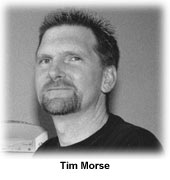
TIM MORSE: I went with some
friends to the show last night [the Regal Theatres event on January
26] and we had a really good time. It was
great fun seeing the acoustic set.
 ALAN WHITE: It was very different. ALAN WHITE: It was very different.
TM: I liked the bluesy sound you were getting on "Roundabout" and "South Side." Was it difficult to translate Yes music into the
acoustic format?
AW: No, not really. It was good to explore that direction this time.
TM: It was kind of a lounge version of Yes or something.
AW: Without going too tongue in cheek, yeah it was kind of like
borderline there. But we decided to do it along those lines there and
it worked out.
TM: I saw it in a packed theater and the crowd really loved it. They
were applauding after the songs.
AW: That's what Gigi [Alan's wife] said. She called last night on the
way home; she went with about seven people to a place [in Auburn, WA].
She said the sound was good, the band came off really well playing
that stuff. It was packed and everybody had a good time.
TM: Since you're celebrating 35 years of Yes I thought I'd start by
asking about when you heard Yes' music for the first time, but I
believe you answered in the DVD last night - I think you said you were
on tour somewhere with Terry Reid?
AW: Yeah, actually I didn't have THE YES ALBUM. I was just in a club
and they were playing it as I was setting my equipment up. And I was
saying, "This is a pretty damn good band!" I think it was "Roundabout"
I was listening to.
TM: Did you ever see them live before you joined, or played with them
on a double bill?
AW: I saw them live once, they were playing Wembley Pool and there was
a bunch of other bands and I only caught the very, very end of the
set. This was back when Chris used to wear his furry boots!
TM: Something in questionable taste! What was your next run-in with
Yes?
AW: I knew Eddie Offord pretty well. I knew that he was their
producer, but I hadn't really heard much of their material until then,
just snatches of stuff.
TM: How did you meet up with Eddie the first time?
AW: Through Terry Reid, I think. We did some recording with Eddie. The
very first time I met Eddie, he was an intern in a studio in
London... what was the name of it?
TM: Was it Advision?
AW: Yes, but not the one where we recorded all the stuff. It was the
first one, which was a very tiny studio on Old Bond St, I think it
was. I was playing with Alan Price and he was an intern there - that
was the first time I met Eddie.
TM: I understand he was quite a character back in those days.
AW: He was always a character, but he was a young intern so he was on
good behavior.
TM: Didn't you end up as roommates at one point?
AW: His parents are relatively rich and they were retiring - they had
an office supply company in Victoria, London. They lived in the
countryside and that was Eddie's apartment, above the office supply
company. He said, "Just come and stay with me," and we shared an
apartment for quite a long time. A lot of that time Yes was recording
Close to the Edge, but I was off doing gigs with Terry Reid and people
like that.
TM: So there wasn't many times where you popped in the studio?
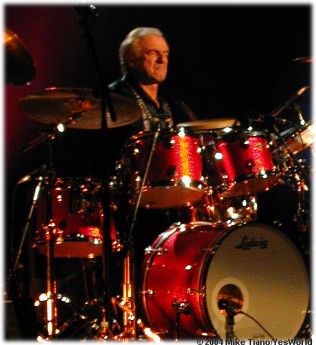 AW: I did a couple of times. One of the times they were recording
"America" when I was there. I did stop in at a rehearsal at... I forget
the name of the place, but I went with Eddie once to a rehearsal. Bill
[Bruford] and them weren't getting on - this is before they recorded
CLOSE TO THE EDGE - and they were playing "Siberian Khatru". Bill had
already left to go to dinner with somebody, I think he was already
starting to meet people from King Crimson. I think Chris had seen me
play with Joe Cocker around that time and he said, "Alan, why don't
you just sit in? It's a bar of seven, then a bar of eight." I sat in
and I had been playing a lot of that odd time meter with my own band
out in the countryside, so I knew how to do it pretty quickly. The
band must have liked the sound of me playing with them, because right
afterwards they asked me to join them! AW: I did a couple of times. One of the times they were recording
"America" when I was there. I did stop in at a rehearsal at... I forget
the name of the place, but I went with Eddie once to a rehearsal. Bill
[Bruford] and them weren't getting on - this is before they recorded
CLOSE TO THE EDGE - and they were playing "Siberian Khatru". Bill had
already left to go to dinner with somebody, I think he was already
starting to meet people from King Crimson. I think Chris had seen me
play with Joe Cocker around that time and he said, "Alan, why don't
you just sit in? It's a bar of seven, then a bar of eight." I sat in
and I had been playing a lot of that odd time meter with my own band
out in the countryside, so I knew how to do it pretty quickly. The
band must have liked the sound of me playing with them, because right
afterwards they asked me to join them!
TM: Obviously you had made a good impression. Yes is celebrating their
35th anniversary as a band, but there is another Yes anniversary to
celebrate: the 30th anniversary of your first studio album with the
band being released, TALES FROM TOPOGRAPHIC OCEANS.
AW: (laughs) Oh really? That's another one!
TM: We'll have to chalk that up. What comes to mind when you think 30
years ago this gargantuan, esoteric album was recorded and released?
AW: We were just into putting lots of pieces of music together at that
time and that's what came out of it. But we all had different little
sections of music and we rehearsed it for three months before we even
went into the studio, so we had a good idea where it was going before
we started recording it. We were in Manticore, ELP's place in town. It
was an old movie cinema that had been converted into a rehearsal room.
TM: Was there ever any concern that it might be daunting to your
audience, that it might be too much?
AW: No, we were just doing what we did. I don't think anybody had any
concerns about that, we were just creating some kind of new music and
getting on with moving the band forward in the music industry.
TM: Well, I guess the proof is in the pudding, because we're talking
about it 30 years later and it's still...
AW: A landmark album from back then.
TM: It's revered. It's been particularly nice in recent years to see
"The Revealing" and "Ritual" dusted off.
AW: They're good songs to play live onstage still. They're different
now, to a degree, because we've refined them onstage a little bit.
It's a more current sound.
TM: To my ears they sound fresher and newer.
AW: I think so, yeah. I think if we had a chance to go back, to make
the album with today's technology we would have made it better than it
is.
TM: Is it true you've been talking about the possibility of reviving
"The Ancient"?
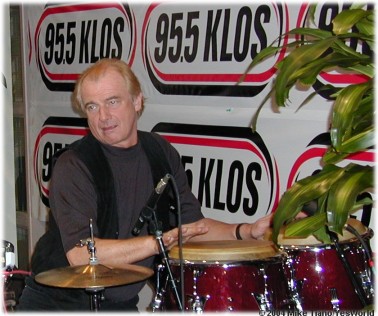 AW: Well, no. I've mentioned it a couple of times, because I think
it's a good piece, but Chris thinks it's too tough for the people. Not
for us to play it, but musically for people to take that much in. But
I'd like to play it again sometime. AW: Well, no. I've mentioned it a couple of times, because I think
it's a good piece, but Chris thinks it's too tough for the people. Not
for us to play it, but musically for people to take that much in. But
I'd like to play it again sometime.
TM: I believe when I interviewed Chris for the "Yesstories" book he
said something along those lines. He thought was all right for the
true Yes aficionados, but maybe a bit too much for everybody else!
AW: The regular Joe (laughs).
TM: I was curious, when you think about tours from long ago. for
instance the '74 tour playing Tales--does it just become a blur of
shows, or do certain shows stand out? "NYC '74, yeah that was a great
night... "
AW: Yes, absolutely. A lot of it is kind of night after night; you get
to play it. But I do remember the challenge was to play the whole of
that [all four sides] with everybody getting everything right. I think
it only happened once. I remember it was in Cincinnati. I came
offstage and I said, "That was it. Everybody got everything right all
night!" There were always one or two little things that went wrong,
because it was such a big piece of music. But I do remember that night
everything was played right by everybody.
TM: Rhino has been doing a great job with doing the re-masters that
have been coming out recently and I was wondering how much input the
band had in the reissues?
AW: Quite a bit. They run everything by us and make sure they are on
the right direction with what we want to do. They're pretty good about
letting us know through the office what they're intending to do and
obviously some one speaks up if they don't like something. I think
we've been satisfied with them so far.
TM: With the bonus tracks starting with CLOSE TO THE EDGE we've gotten
rough mixes, run-throughs and demos, with scratch vocals and things
like that. Some are revelations in terms of the working process, the
songwriting process of the band.
AW: Well, you can hear it when you listen to those kinds of things.
TM: Was there any reservations about issuing that material?
AW: I think that's what the band is trying to do for the 35th
anniversary is to let people have a look on the inside workings of it
as well as what they hear as the finished product. So that partly is
why we did the acoustic thing, we changed it this way for this time so
people could see how we work.
TM: You and I haven't had much of a chance to talk about
MAGNIFICATION. I honestly believe that it's one of the best Yes albums
since GOING FOR THE ONE.
AW: It's good, yeah there's a lot of great stuff.
TM: Again I think it comes back to the songwriting. The songs are
really strong pieces of music. How did the songwriting process work on
that project?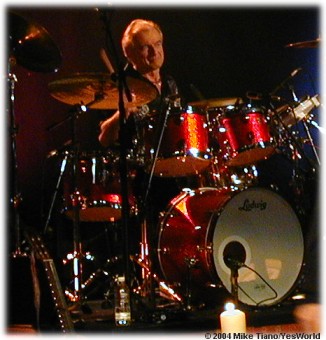
AW: That album came down to Chris, Jon, Steve and myself. Just the
four of us creating something with Larry. He came in every few days
and found out what we were doing and came up with orchestral parts. We
would leave sections of the songs open with that in mind, so the
songwriting process had to encompass that too. It was the four of us
together in a room, the first time we'd just done it with the four of
us.
TM: It definitely worked a trick. Songs like "Dreamtime" and "Give
Love Each Day" are great pieces of music. I was hoping that
Magnification wouldn't be ignored on the next tour. In fact it was a
nice surprise to hear "Time is Time" last night.
AW: Yeah, that one came out of the woodwork. We hadn't actually done
it onstage ever!
TM: That was one of the favorites from last night. While we're on
MAGNIFICATION the song "Can You Imagine" was a leftover from the XYZ
sessions; did you have a writing contribution on it?
AW: It was more from Chris, I just played the piano part initially. I
might have changed a few things, but it was minimal. Most of it was
Chris' writing.
TM: What about "In the Presence Of"?
AW: That was my thing. Jon contributed the vocal melody and the lyric.
TM: So you wrote the musical backing?
AW: It's all mine, yeah.
TM: Another Yes classic. What are the plans for recording another Yes
studio album?
AW: I think everybody's been writing with the view of doing something
later in the year after we've done a bunch of touring. But the main
thing is starting this Springtime tour and then go to Europe for two
months and then come back here for another month. And they're talking
about us going back to other countries like back to Australia. Who
knows when we'll get the time to record, but we've all got songs ready
in the waiting.
TM: It's shaping up to be a really big year for the band. Can you tell
me what to expect on this upcoming tour?
AW: We're still kind of in the planning stage. I know that Roger Dean
is involved with the stage, we've got blueprints of where the drums
should be, etc. It's starting to be worked on right now. I think
you're going to find a very different set. Jon just threw this set
list at everybody the other day that's kind of bizarre! We all looked
at him and went, "Yeah!" It's different, we want to definitely avoid
songs we've played over the years and try some different material that
people will enjoy. Jon had a few mind-blowing songs on there, but
we'll see what happens. There was some '80s stuff on there too; it can
be hard to get Steve to play some of the '80s material. He wasn't too
knocked back by it. He said, "We'll have to talk and think about it,"
but at the same time it wasn't an absolute no.
TM: I'm sure with the set lists it's got to be a big give and take
compromise situation for everyone.
AW: I've been doing it for years, because I play the stuff Bill played
on. I don't mind as long as they do incorporate things like RELAYER
that I help create. We're going to have to play things like "And You
And I" because they're very stalwart type of numbers, but this set is
a little different from that, it could be a very interesting set for a
lot of people.
TM: I did an interview with Rick last year and he told me an
interesting story about recording CRIMINAL RECORD and your involvement
on it. He said that he played all of his keyboards and then he invited
you and Chris to come in and write and record your parts and he wasn't
anywhere near the studio when you did it.
AW: No, you know something? I wasn't even in the studio with Chris, I
think we both did them separately!
TM: You're kidding!
AW: That's the way we worked in those days, we used to do it like
that. I think that Rick was there once, but he might not remember. He
came in and said, "That sounds great," and I got on with the next
track. But we related to some degree. But I think Chris and I did
everything separate as well, I just tracked the drums.
TM: Did you lay your part down first and then Chris played his?
AW: I believe that was the way it went. I was just playing to
keyboards.
TM: And there was no click track, right?
AW: It was pretty easy, some of that stuff was pretty straightforward.
It worked out, Rick liked it and if anything did go astray he just
redid the keyboards to me.
TM: One more thing about the tour, this isn't going to be billed as a
farewell tour is it?
AW: No! Not at all, we're just going to carry on just doing what we're
doing.
TM: Good, I'm certainly glad to hear that. I'll wrap this up on a
personal note. I was listening to a live version of "Gates of
Delirium" the other day and I was really moved. Sometimes I can take
this band for granted, but then it will hit me how special and unique
it is. I was wondering if you have moments where it hits you too?
AW: Yeah, I've felt like that before. Especially when we get things
really going onstage, after we've been playing about a week. When it
really starts hitting home that's when this band is rocking. |